top of page


Taparch Footwear
UX DESIGN · HEALTHCARE · UX RESEARCH


INTRODUCTION
TAPARCH, gets it's name from the arch-tapping mechanism that's the core of the idea. During the late 2010's many were theorizing a haptic shoe for the visually impaired that would ideally replace the iconic 'white cane'. We at Tapinnovations (now INDQ) had the technology in the cradle, we just needed it to take it to the streets.

MY ROLE
UX Design & Research,
THE TEAM
1 Designers, 3 Engineers, 2 Engineering Interns
TIME LINE
June 2018 — Oct 2018
My Role as the Lead designer here was to study & develop meaningful user stories rendering the user's experiences as well as drive the User Experience Design System for the start up
BACKGROUND
'What a blind person needs is not a teacher, but another self.' - Hellen Keller
However unlike the unimpaired, they face many day to day problems in their life which could do with a tentative amount of design intervention.
KEY STATS
285 Million people are estimated to be visually impaired worldwide: 39 million are blind and 246 have low vision.
About 90% of the worlds visually impaired live in low-income settings.
82% of people living with blindness are aged 50 and above
Globally, uncorrected refractive errors are the main cause of moderate and severe visual impairment; cataracts remain the leading cause of blindness in the middle and low-income countries.
The number of people visually impaired from infectious diseases has reduced in the last 20 according to the global estimates work.

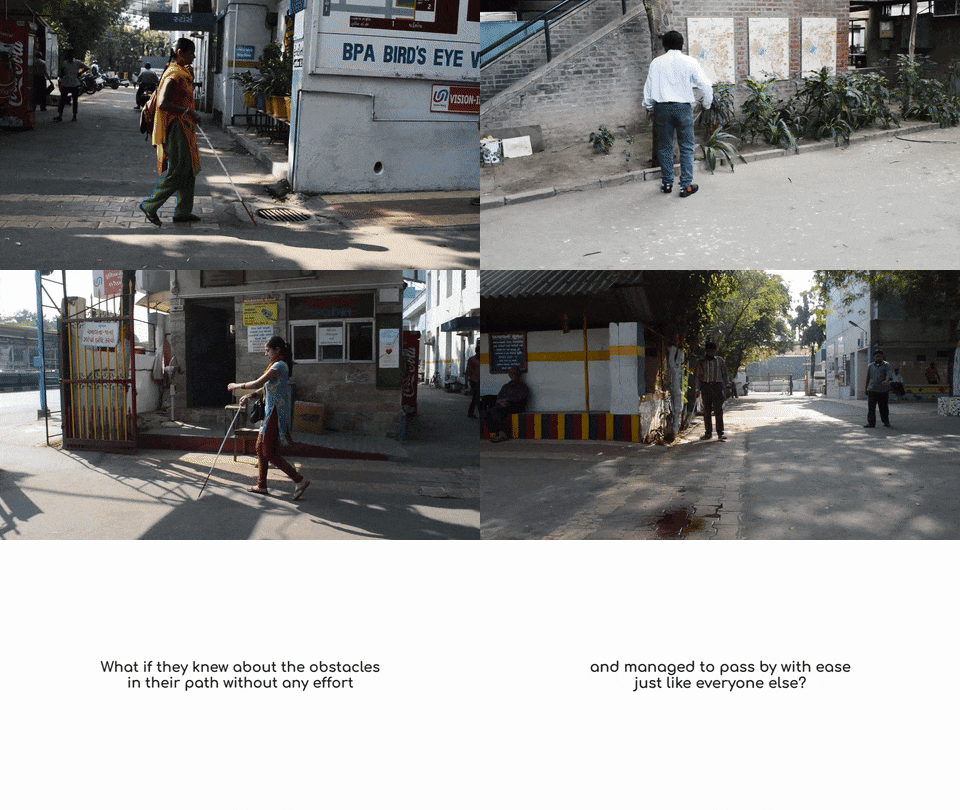
Our collaborative partner BPA (Blind People's Association) is a research/training school that hosts many experts to develop inclusive solutions for the visually impaired apart from training children and adults. We were given access and resources to interact, research for months to gauge insights into the life of the visually impaired.
CORE TAKEAWAY:
Labelling the visually impaired 'disabled' apart from being demeaning, is factually wrong, because they, after training are as enabled as us perhaps even more enabled in certain ways.

Reading without Braille
The lack of adoption of Braille in signage and in everyday lifre compels them to heavily rely on their memory to figure it out

Accessing Technology
The availability of assistive technology is increasing, along with accessibility of IT to all potential users, but it still awaits widespread adoption in our country's policy making strategy.

Communication
The biggest obstacles in communicating with the visually impaired usually comes from face-to-face interactions. Non-verbal factors hinder communication for them more often than verbal factors do.

Social Development
As subtle visual cues are missing & facial expressions from others are lost, they appear to be disinterested in social activity with peers and un-educational on how to communicate with other people
To avoid the visually impaired. feeling rejected, people need to treat the blind the same way they would treat anyone else, rather than treating them like they have a disability, and need special attention.
People may feel that it is improper to, for example, tell their blind child to look at them when they are speaking, It is important to disregard any mental fears or uncomfortable feelings people have while communicating (verbally and non verbally) face to face.

Independent Mobility
Cane training, Guide dogs, GPS devices and even Echolocating training doesn't instil in people with serious visual impairments the same sense of freedom in an unknown location.

Using Aids
Many household appliances, currencies, documents, tools and measuring equipment are not blind-friendly compelling the visually impaired to devise their own adaptive strategies in all areas of personal & professional management.

Adjusting Attitude
There's a need to come up with a method to reduce individuals being uncomfortable with communicating with the visually impaired.

Access to Healthcare
They have limited access to information and healthcare facilities, and may not receive the best care possible because not all health care professionals are aware of specific needs related to vision.
USER INSIGHTS
Choosing 'Independence Mobility' as the core intervention space was in the name itself. It was the most fundamental space to gauge independence.
PRIMARY MOBILITY OPTIONS
.png)
Cane Training
The cane training received during the formative years is not only necessary but also help them effectively navigate areas that they are familiar with. But what cane training doesn't prepare them for is how to navigate unfamiliar areas, not to mention their one hand is always holding the apparatus which could have been free.
Guide Dogs
A small no of people employ guide dogs. These dogs are trained to navigate around various obstacles,& to indicate when it becomes necessary to go up & down a step. However, the helpfulness of guide dogs is limited by the inability of dogs to understand complex directions. The human half of the 'guide dog team' does the directing, based upon skills acquired through previous mobility training. In this sense, the handler might be likened to an aircraft's navigator, who must know how to get from one place to another, and the dog to the pilot, who gets them there safely.
TERTIARY MOBILITY OPTIONS
.png)
GPS Devices
GPS devices can also be used as a mobility aid. Such software can assist blind people with orientation & navigation, but it is not a replacement for a traditional mobility tools such as white canes & guide dogs
.png)
Echolocation Training
Some blind people are skilled at Echolocating silent objects simply by producing mouth clicks & listening to the returning echoes. It has been shown that blind echolocations experts uses what is normally the 'visual' part of their brain to process the echoes,
.png)
Systemic Inclusivity
Govt actions are sometimes taken to make the public places more inclusive to the blind. Tactile paving & audible traffic signals can make it easier & safer for visually impaired pedestrians to cross streets. In addition to the making rules about who can & cannot use a cane, some govts mandate the right-of-way be given to users of white canes or guide dogs.
PROBING TOOL
Over the time we spent in BPA, it was becoming abundantly clear the mobility is clearing centred around the 'long white cane' as it becomes an extension of the arm.
'The long white cane' in the terms of Philosopher Marshall McLuhan was a perfect example of a media being an amplification/ amputation as it was intended to be an extension of the human arm
.jpg)


USER INSIGHTS
Theory behind the cane length
The long white cane is the one of the world's oldest products & definitely one of those which have perfected over centuries. The cane training alone has developed to such an extent which shows the amount of thought & intuition that must have gone into enabling the visually impaired.
While we were researching a person's journey from denial to freedom. We could see patterns in the stories of many of the visually-impaired users who's cases we studied & researched upon.
In search for a scope of intervention we found that there are no corrections to be made to the product; rather we understood the basic concepts & principles which made the framework function so efficiently.
But no system is perfect. And nothing can be made perfect. And nothing can be made perfect, but what we can strive for here is to get nearer & nearer to it. So here are the some of the observations we have made which could be improve upon.
RECURRING INSIGHTS
Analysis of Cane Training.
The first issue is to find the reason for the lack of popularity of cane training. Fear of the unknown is the greatest enemy.
.png)
Agoraphobic Tendencies
Most visually impaired fear going to new places all by themselves. In most cases the fear of being in an accident keeps them confined to their homes.
.png)
Assisted
Casing
Either they do not go out at all, or they wait until a sighted member to accompany them. What they don't realise that is a blind person can safely & confidently travel anywhere.
.png)
Inclusive Behaviour
The cane & the dog are just tools. It is not simply a device telling others that they are blind & the others either ought to stay out of their way or ought to rush sympathetically to preserve such a helpless creature/
REASONS FOR INCOMPLETE CANE TRAINING
The long white cane must be recognized as a device that blind people use as a tool of independence.
The blind should not be made to feel ashamed to be seen with their cane. Until they are properly trained & feel comfortable walking with their canes, they wont be able to project an image of confidence while walking & get treated with proper respect.
A person who usually looks lost or bent over, groping with a short cane, strangers often react to them as if they were disoriented & unsure of themselves. This view of blind people perpetuates the myth of helplessness that has for too long kept them from achieving first class status.
USER INSIGHTS
Theory of cane length
It has often been recommended that the people who don't have the luxury of working with a good cane travel teacher regularly being with a cane that is 2 to 4 inches longer than the one they are used to travelling with. The increase in the amount of information obtained will be immediate & noticeable. As one's skill & confidence increase, one will instinctively replace each cane with a longer one until the right cane length is achieved. Many can travel teachers suggest that the cane should come up to the chin. Faster walkers will want somewhat longer canes.
4 inches less than your height


Below Chin Level
Chest Level
RECURRING INSIGHTS
Analysis of Cane Training.
Certainly there is no way for blind people to avoid all accidents, just as there is no way for a sighted person to do so. When studied, many accidents, which occur, the prime reasons usually are a lack of attention to what one's doing, a short cane & a lack of skill in wielding it. (More than 15 percent of children with vision impairment also had an ADHD diagnosis, compared with 8.3 percent of children with normal vision) A properly sized cane should sweep two to three steps in front of the user who is walking at a normal pace.
.png)
EXTREME CASE SCENARIO
Longer Steps
More Confident Body Language
Seeing farther in a sense
General Speed
With a longer cane the user starts to walk upright & with greater speed.
.png)
WALKING OFF A LEDGE
Having more time to stop
Same walking speed
Feedback from farther away
More time to decelerate
GPS devices can also be used as a mobility aid. Such software can assist blind people with orientation & navigation, but it is not a replacement for a traditional mobility tools such as white canes & guide dogs
Having more space to stop
Feedback from farther away
WALKING INTO A WALL
.png)
Same walking speed
More space to decelerate
GPS devices can also be used as a mobility aid. Such software can assist blind people with orientation & navigation, but it is not a replacement for a traditional mobility tools such as white canes & guide dogs
FINDINGS
The short cane does not allow the user to walk upright. It also does not give one adequately early enough warning of obstacles in front of them. In most cases of accidents, the length of a cane delivers earlier feedback, results in having adequate time to react & enables them to decelerate before falling or bumping
BACKGROUND RESEARCH
Reasons behind the popularity of short cane
The biggest trick to conscientious management of a cane is to remember it. One should always know where both ends of the cane are & should keep them out of patterns of traffic. If you can't tell whether the cane is stowed safely, ask someone else if it is out of the way.
.png)
Getting caught in every Crack in the sidewalk
Most occurring snag in the process is its tip gets caught in every crack in the sidewalk
.png)
Hard to stow safely & quickly in a car
It's hard to stow safely and quickly in a car. There are some cars manufactured in the developing world that really are too small for a long straight cane.
.png)
Hard to use safely & courteously in a crowd.
It's hard to keep out of people's way when it's not in use
REASONS FOR INCOMPLETE CANE TRAINING
The genuine importance of 'the pencil grip'.
Travelling safely & considerately has it's own tricks & rules. In the wide open spaces of an empty sidewalk, the cane tip can arc freely, making a small angle with the ground. The problem is that a cane held in this position can be dangerous to people in front of the user if the tip gets between their legs or under one foot.
The more densely crowded an area, the more nearly vertical the cane should be held. The larger angle formed by the cane & the ground decreases the distance one can sweep, but in a crowd one does not need as much stopping time or distance since one's speed is necessarily slowed.
As soon as the path opens again, with a flip of the fingers the cane will slide back out to it's full length. Thus the insight we get from the knowledge is that in an ideal scenario the range of the sensing technology has to be not only changeable but controllable as well.
.png)
The pencil grip is the best way to hold a cane in the crowd since one has the maximum control in this position, & the hand can slide quickly & easily down the shaft of the cane in order to shorten the length being used.
CONCEPT DEVELOPMENT
How we arrived at the concept of 'The Tapping Arch'
On brainstorming & going through selection by elimination based on feasibility. we came to the ideas of wearables, their possibilities & on further reflection on points such as sensing at obstacles at ground level (tripping / tipping) & at the same time sensing the ones near head level, we landed on the idea of a near-haptic footwear. On further market studies of competitive products, we came to know the failure points of other symmetric wearables such as belts, glasses and caps. Thus on deciding on footwear we started ideating on how we would make it work?
SENATOR STERN: IF SUIT IS NOT A WEAPON, HOW WOULD YOU DESCRIBE IT?
TONY STARK:
USER TESTING
Prototyping, User testing & Feedback
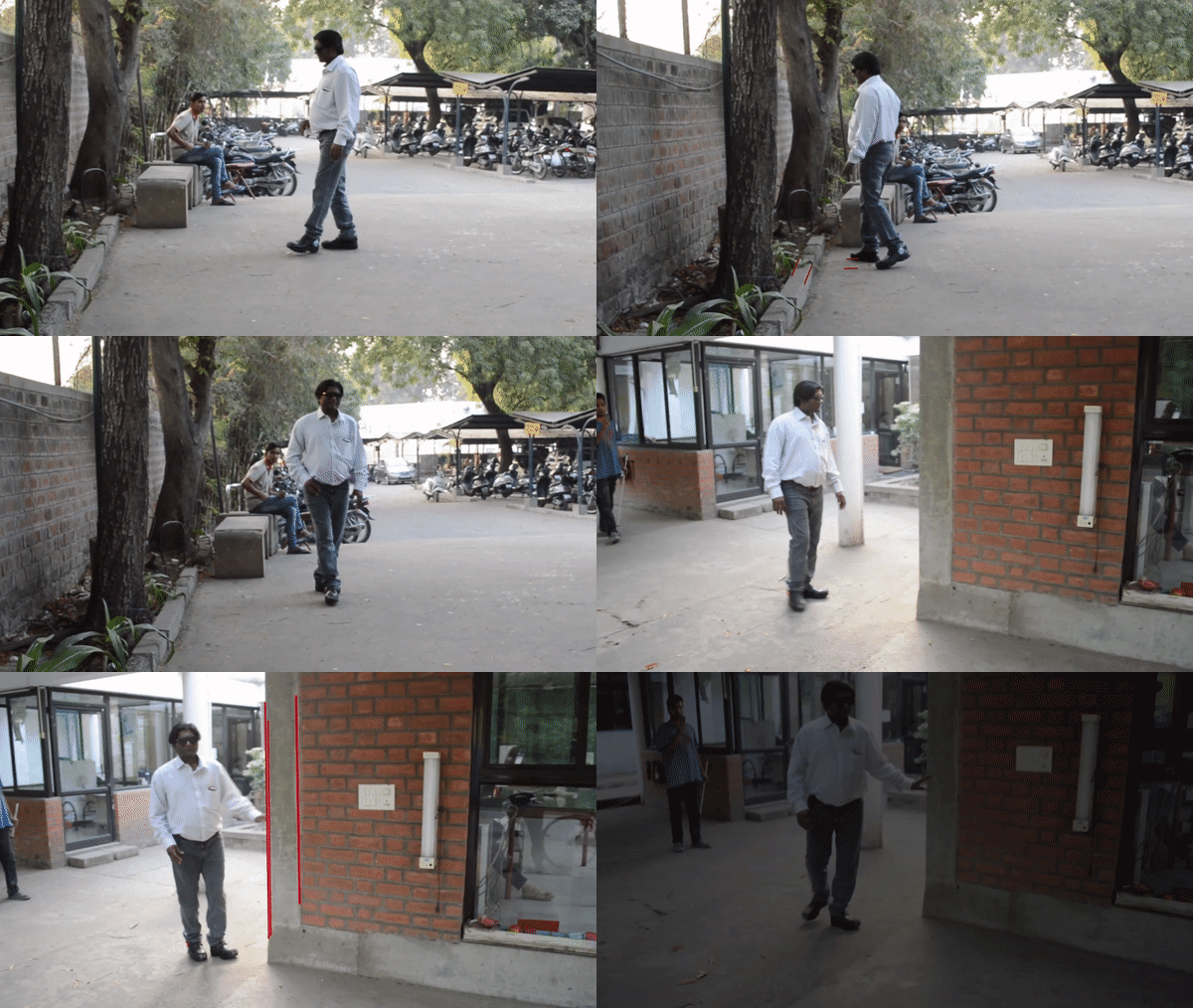
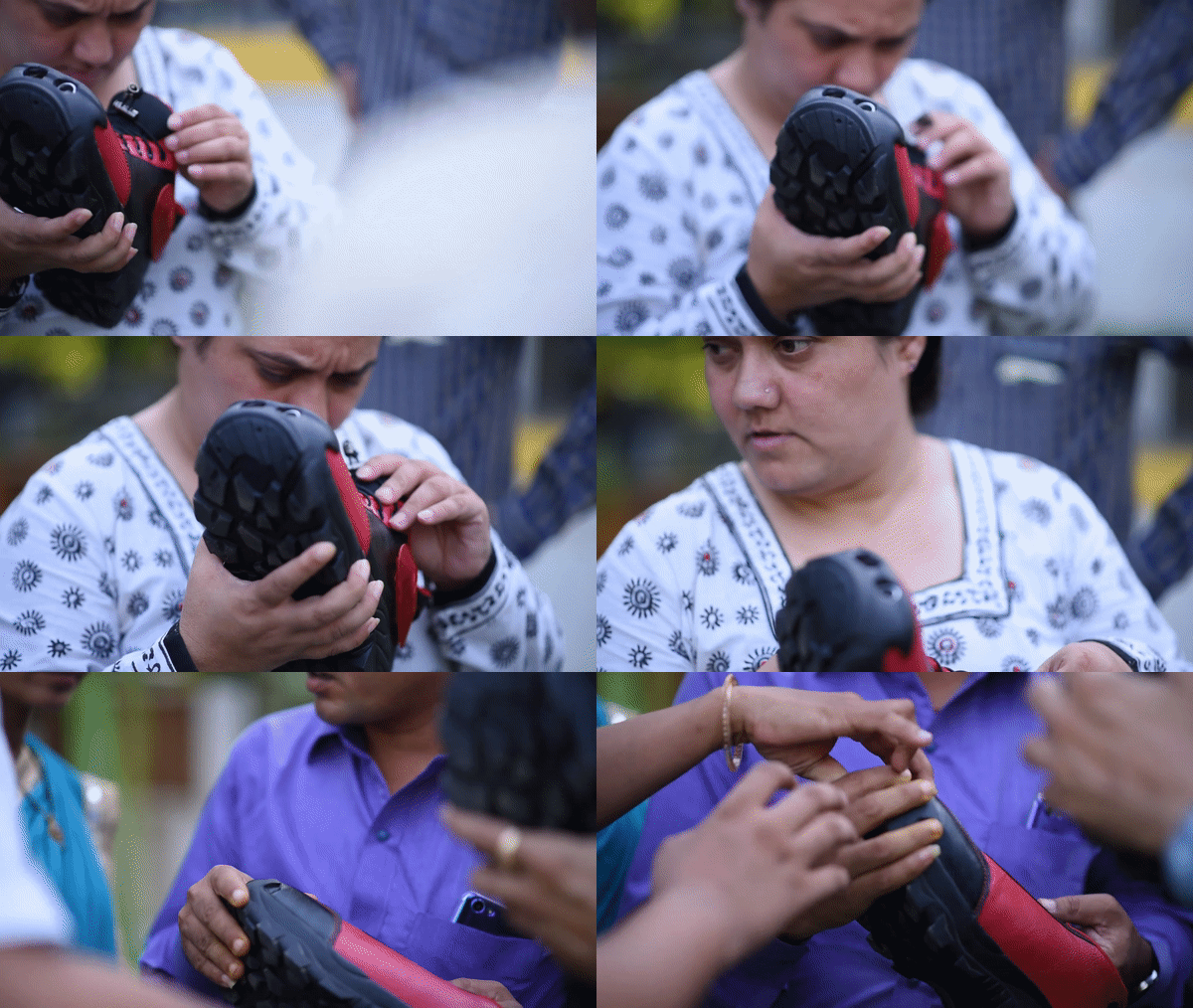
On making sure the user had used the product fairly, we reviewed our primary observations & feedbacks. Firstly the user could be satisfactorily explained about the functions of how the prototype works & how they are supposed to use it. Secondly, even without the instructions the user easily figured out the function & usage of the shoe in about 15 minutes, confirming the underlying proof of concept & the affordance. The user also gave us valuable insights regarding the make of the footwear & feedback mechanism.

Why Tapping?
Tapping technology be introduced in the feed-back instead of vibrations as people have ambiguous perceptions about health implications of vibrations.

Cant be covered
The footwear should not be a shoe. Tropical countries need footwear to be versatile, breathable, heat dispensing, waterproof & easy to wear.

Why Footwear?
The tech should be installed in the footwear on both the feet increasing the angular range of the ultrasonic sensing & difference in the intensity or frequency in tapping in each feet feeding you the direction of the obstacle
Robust


Should be robust like a safety shoe
User interface
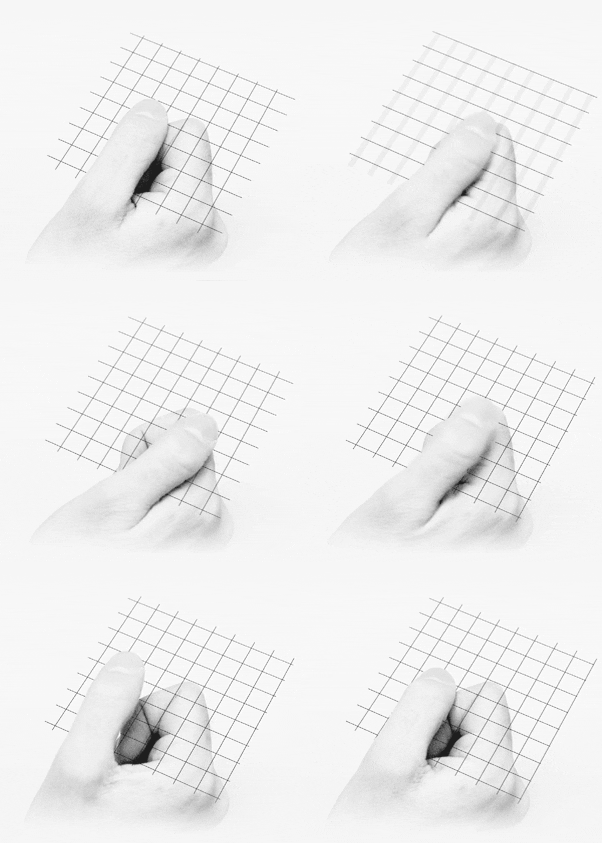
The user interface required for the user to turn it on-off or control the intensity or set modes of usage along the buzzers & sounds as feedback in the NUI

Sensitive in its feel
The footwear has to be soft & sensitive for feeling the texture of the ground (slippery/ rough)
PROTOTYPE I & II
After solidifying the concept & having a better vision about what we wanted. We started by giving our prototype to a user for a tentative period of time for further feedbacks


PRESENTING TAPARCH
Features and Functions
The final features were integrated after an intense process of feedback & user testing

KEY STATS
Cost-effective: Costing just as much as your typical pair of footwear. Striving to provide way more functionality while keeping the costs down
Energy Generator: Taparch has a built in mechanical harvester, which generates electricity as you walk. An efficient nano-wattage circuit ensures that Taparch is used more & charged less.
Enhanced Aesthetics: Not only are the visually impaired quite visually conscious, but their understanding of beauty is quite visual too.
Minimal Interface: With just two buttons, Taparch is simple to operate. Functions for each button are clearly defined so that you don't have to remember complex procedures.
Durable: It is strong enough to handle rough use. so that walks aren't limited just on the road. It is strong yet breathable, so that you don't feel uncomfortable even after wearing it for hours.
Low Maintenance: Taparch can be treated just like your regular shoe - no special maintenance required to operate it.
Mistake proofing: Defects are rare but even for one of those rare times, Taparch let's you know through a buzzer which emits sound intermittently when the shoe faces a glitch
Minimal Interface: Outer sole of Taparch is designed after detailed research & thorough testing to provide extra grip, so you can walk on any surface with confidence.
The tech is installed in the footwear on both the feet increasing the angular range of the ultrasonic sensing & difference in the intensity or frequency in tapping in each feet feeding you the direction of the obstacle


On/Off,
Mode switch
There's a 30 degree between the sensors in each shoes. in order to detect horizontally parallel obstacles in one & immediate depressions in terrains with the other.

2m
GENERIC MODE
CROWD MODE
0
1m
2m
0
1m
Tap Intensity
Tap Intensity


REFLECTIONS
Positive Testimonials
This highly awaited product has gone into production and on arrival we were planning to launch our 'Phase III' of our User Testing after the success of the first two. This product was a labour of love & compassion. After getting many pre-orders, volunteers for testing & love from the community in general, we are hoping to launch it into the market by 2017. Not to mention Tap Innovations will keep on continuing with social innovations in the field of physiological, psychological and other disabilities and disorders.
Cheers.

Showcasing the concept in Vibrant Gujrat Trade Fair
bottom of page